By Sharron Van
“I drew this piece to celebrate the different cultures that exist in my closest friend group and women in the arts—in this case, dance and performance art. This illustration is heavily influenced by my city’s fervent love of diversity, as well as by the Buddhist artwork I grew up admiring. Cultured Pearls was spurred on by a trend online that played a snippet from the song ‘Honor to Us All’ from the movie Mulan, while images or videos of similar subjects (i.e., women dancing, animated films, etc.) appear in sync with the beat.
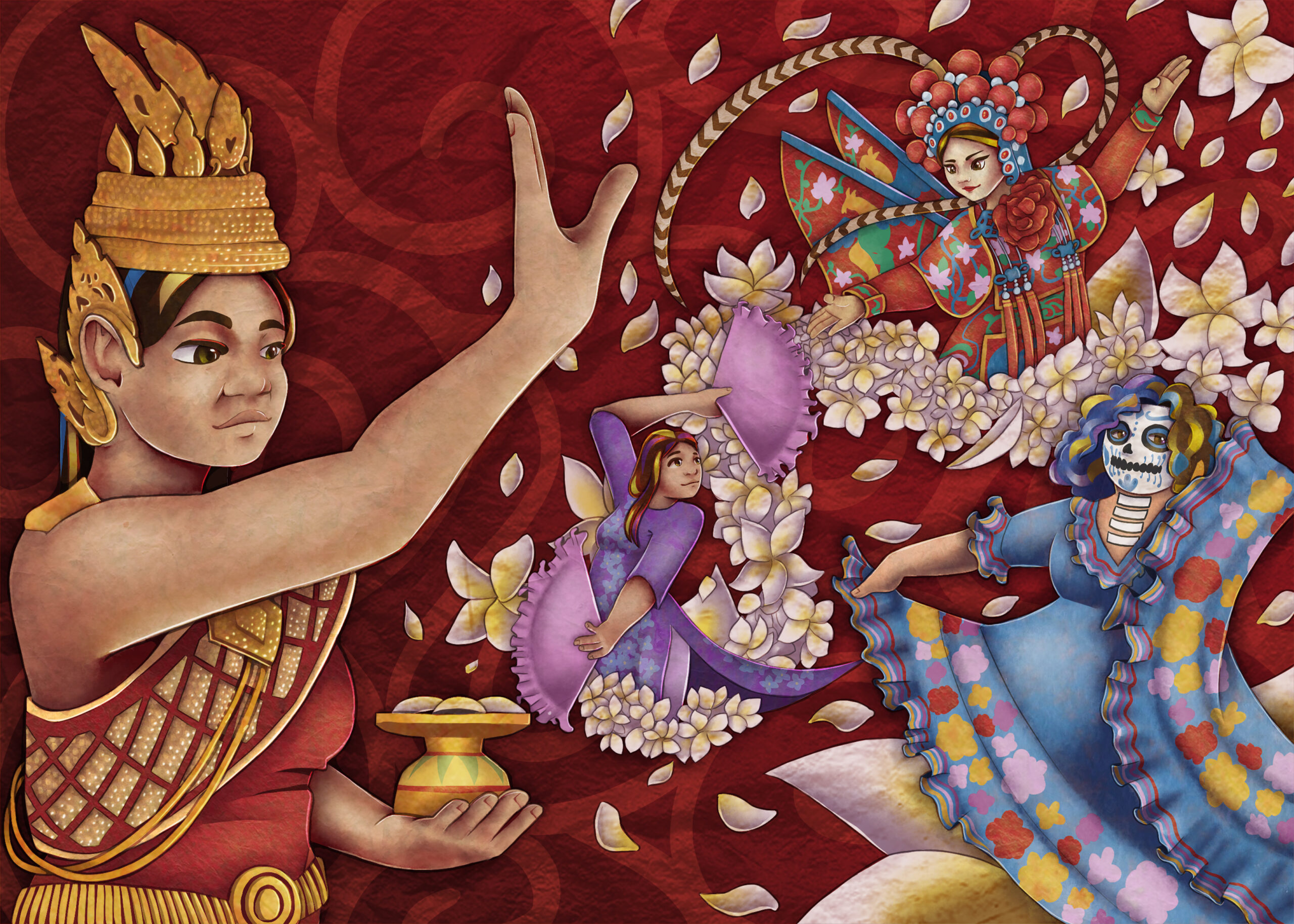
My best friend, who is Cambodian, is performing the blessing dance ‘Robam Jun Por’ which is performed ahead of ceremonies, celebrations, or important events to give blessings to guests. Historically, the dance was used to cast away bad spirits or negative energy, with the champey flowers inside the goblets representing beauty, resilience, and grace. The flowers from the small plate in her hand blow the flowers to the other dancers in the composition.
The first dancer in a purple ao dai, the traditional dress of the Vietnamese people, is performing a traditional Fan Dance. This dance is accompanied by music and is used to welcome the beginning of important events, and now is used to showcase the beauty of Vietnam in international showcases. It emphasizes grace, aiming to mimic the fluidity of water, and is performed in groups to promote unity and community among the people watching it.
The woman in the blue dress is celebrating Día de los Muertos, a holiday honoring life and ancestors. A large part of the holiday includes dance as a way to honor the dead, dancers don colorful makeup and costumes, dancing to lively music. Big, playful movements and the representation of the dancers as ‘skeletons’ promote the idea of continuity and a continued dialogue between those who have passed on and those still in the living realm.
Lastly, the woman on the top is in the traditional costume of Peking Opera, a theater form that involves dance, singing, and acting. The art form is used to pass on mythology like the famed Journey to the West or to instill morals within the audience. It is traditionally performed on a stage, but has spread to television and other forms of digital media. Growing up, I would wake up to Chinese Opera every morning, and while I could not quite understand what the characters were saying, I was always enamored by the artistry of its distinct, high-pitched sound and elaborate costuming—particularly in its iconic headdress and striking makeup.
Our connection to these performances largely lies in our growing up interacting with these dances during important festivities—as the Clayton County area hosts a variety of cultures within its space. As children of immigrants, dance is one of the many ways we get to connect and experience our cultures authentically. The dances not only represent commemoration, blessing, and good luck, but they largely rely on women to carry on the tradition. In the case of Robam Jun Por and the Vietnamese Fan Dance, it is mainly women who perform them. While dances on Día de los Muertos can be performed by either gender, women have been at the forefront of representation in this art form. Meanwhile, women were outlawed for much of Chinese history from performing in Peking Opera. This changed during the 1930s, when actors were willing to take on female apprentices. This is symbolic of the female resilience in a male-dominated field, and the idea of the ‘Nan Dan’—a character archetype popular before the 1950s, where a man plays a female character so well he is indistinguishable from a woman, is also proof that even when women are outlawed from expressing themselves, they are necessary for the preservation of story and therefore, art.”